Proven Habits of Millionaires to Help You Achieve Financial Freedom
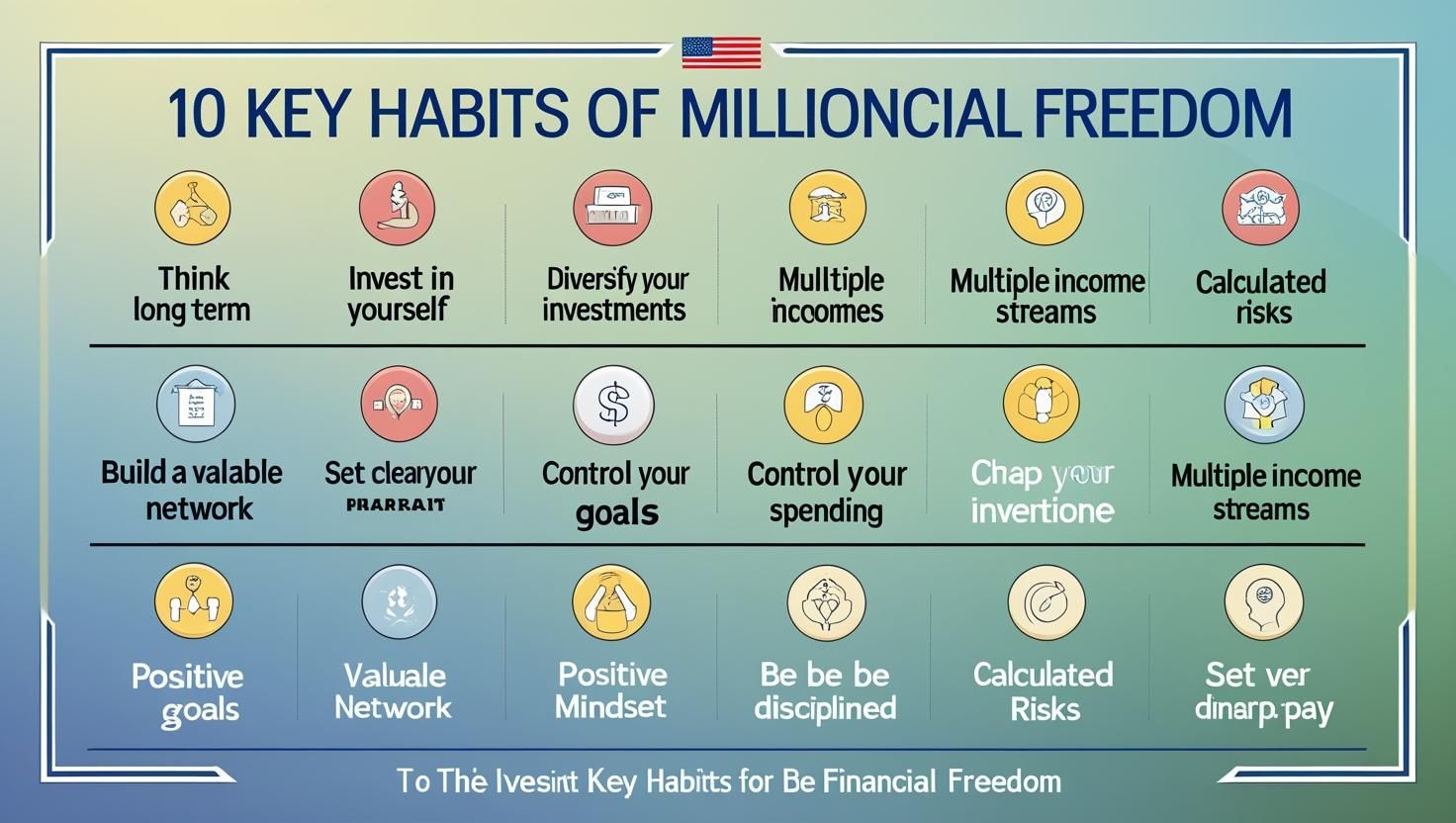
Let’s be honest, friends: most of us have looked at a millionaire and thought, "They must have been born lucky," or "They probably hit the lottery." While a bit of luck never hurts, the truth is far more interesting—and far more empowering. When you peel back the curtain on self-made wealth, you don’t find a magic wand; you find a set of repeatable, boring, and disciplined habits.
Proven Habits of Millionaires to Help You Achieve Financial Freedom
Financial freedom isn't about having a million dollars in a bank account so you can buy a gold-plated yacht. True financial freedom is the ability to wake up every single morning and decide exactly how you want to spend your time without worrying about how you'll pay the rent. It's about autonomy. It's about peace. And most importantly, it's about a mindset shift.
We often focus on the "what"—the cars, the houses, the luxury vacations. But if you want to get there, you have to focus on the how.The "how" is hidden in the daily routines of people who have already cracked the code. In this guide, we're going to dive deep into the psychological and practical habits that separate the wealthy from the merely comfortable.
The Psychology of Wealth: It Starts Between the Ears
Before we get into the spreadsheets and the investment accounts, we need to talk about your brain. You see, most of us were raised with a "scarcity mindset." We were told that money is tight, that rich people are greedy, or that you have to work 80 hours a week in a cubicle to make a decent living. Millionaires, however, operate from an "abundance mindset."
Viewing Money as a Tool, Not a Goal
One of the biggest mistakes we make is treating money as the finish line. If your goal is simply "to have a million dollars," you'll likely stop growing once you hit that number. Millionaires view money as a tool—like a hammer or a screwdriver—that allows them to build a life they love and create more value for others. When you shift your perspective from "getting money" to "creating value," the money starts to follow you.
The Power of Delayed Gratification
This is the hardest part, friends. We live in the era of "Buy Now, Pay Later." We want the new i Phone, the trendy sneakers, and the fancy dinner right now. But the secret weapon of the wealthy is delayed gratification. They are willing to live like they are broke for five years so they can live like royalty for the next fifty. They understand that spending $1,000 today on a gadget is actually costing them $10,000 in future gains if that money were invested in a compounding asset.
The Core Habits: The Blueprint for Wealth
Now that we've got the mindset sorted, let's get into the nitty-gritty. These aren't "hacks"; they are habits. A hack is a shortcut; a habit is a lifestyle. If you implement these, you aren't just chasing money—you're building a machine that generates it.
1. The Obsession with Learning (Continuous Education)
If you think your education ended the day you got your diploma, you're already behind. Millionaires are voracious readers and lifelong learners. But here is the key: they don't just read for entertainment; they read for application. They study psychology, sales, leadership, and finance.
We often see the "millionaire's library," but what we don't see is the notebook next to the book where they are scribbling how to apply a concept to their business. Whether it's podcasts, seminars, or mentorships, the wealthy invest in their own brain because they know that their earning capacity is directly tied to their learning capacity.
2. Paying Yourself First
Most people follow this formula: Income - Expenses = Savings. The problem is that expenses always expand to fit the income (this is called Parkinson's Law). By the time they get to the "savings" part, there's nothing left.
Millionaires flip the script: Income - Savings = Expenses. This is called "Paying Yourself First." The moment a paycheck or a business profit hits their account, a predetermined percentage (10%, 20%, or even 50%) goes straight into investments. They force themselves to live on the remainder. This ensures that wealth grows automatically, regardless of how tempting the latest sales are.
3. Diversified Income Streams
Depending on a single paycheck is the most dangerous financial position you can be in. If you have one job and you lose it, your income drops to zero instantly. Millionaires rarely rely on one source of income. On average, self-made millionaires have at least seven streams of income.
Common Income Streams Include:
- Earned Income: Your salary or freelance fees.
- Dividend Income: Money earned from owning stocks.
- Rental Income: Money from real estate properties.
- Interest Income: Money from lending or high-yield accounts.
- Profit Income: Money from owning a business.
- Capital Gains: Selling an asset for more than you paid for it.
- Royalty Income: Money from writing a book or creating a patent.
You don't need all seven tomorrow, but you should be working toward adding one new stream every year. The goal is to reach a point where your passive income (the money that comes in while you sleep) exceeds your living expenses. That is the exact moment you become financially free.
4. Strategic Networking and the "Inner Circle"
You've probably heard the saying, "You are the average of the five people you spend the most time with." It's a cliché because it's true. If you hang out with four people who complain about their boss and spend their weekends binge-watching shows, you'll likely be the fifth. If you hang out with four people who are discussing market trends, scalability, and investment strategies, you'll be the fifth.
Millionaires are intentional about their circle. They seek out mentors who are 10 steps ahead of them. They don't just "network" to get something; they look for ways to provide value to others first. Wealthy people attract other wealthy people through a mutual exchange of value and ambition.
Deep Analysis: Why Most People Fail
If these habits are so "proven," why isn't everyone a millionaire? Because these habits are boring. Investing $500 a month into an index fund for 20 years isn't a sexy story. Starting a side hustle and failing three times before the fourth one works isn't a "viral" moment. Most people quit during the "boring middle"—the period where you're doing all the right things, but the results aren't visible yet.
This is where the concept of Compounding comes in. Compounding is the eighth wonder of the world. In the beginning, it looks like nothing is happening. But then, it hits a tipping point. The growth becomes exponential. The tragedy is that most people stop just before the curve turns upward. To achieve financial freedom, you have to survive the boring middle with unwavering discipline.
Actionable Steps You Can Take Today
We don't want this to just be a "feel-good" read. We want you to actually change your bank account. Here is how we start:
Step 1: Audit Your Outflows
For the next 30 days, track every single cent. Not because you need to be stingy, but because you need to know where your "leaks" are. You can't manage what you don't measure.
Step 2: Automate Your Wealth
Set up an automatic transfer from your checking account to a brokerage or savings account the day you get paid. If you never see the money, you won't miss it.
Step 3: Identify Your "Value Skill"
What can you do that people will pay for? If you don't have one, your first "investment" should be a course or a book to learn a high-income skill (like copywriting, coding, digital marketing, or sales). This increases your "earned income," which gives you more fuel for your "investment income."
Step 4: Curate Your Feed
Unfollow the accounts that make you feel like you need to spend money to look successful. Follow the people who talk about assets, equity, and long-term growth. Change your digital environment to match your financial goals.
Questions and Answers
Q1: Do I need a lot of money to start investing?
A: Absolutely not, friends. Thanks to fractional shares and micro-investing apps, you can start with as little as $5 or $10. The most important factor in investing isn't the amount of money—it's the amount of time. Starting with $50 a month at age 20 is often more powerful than starting with $500 a month at age 40 because of compound interest.
Q2: Should I pay off all my debt before I start investing?
A: It depends on the "flavor" of the debt. High-interest debt (like credit cards at 20%+) is a financial emergency; pay that off first because no investment reliably returns 20%. However, low-interest debt (like a 3% mortgage) can be managed while you invest, as you can potentially earn 7-10% in the stock market, creating a positive spread.
Q3: What if I don't have an "entrepreneurial" personality?
A: Here's a secret: you don't have to start a company to be a millionaire. There are plenty of "Millionaire Next Door" types who worked steady jobs, lived frugally, and invested consistently in index funds. You don't need to be a CEO; you just need to be a disciplined owner of assets.
Q4: How do I handle the fear of losing my money in the market?
A: Fear comes from a lack of knowledge. When you understand that the market has historically always gone up over the long term, the short-term "dips" become opportunities to buy assets on sale. The key is to never invest money you need for rent next month. Keep an emergency fund of 3-6 months of expenses so you can stay calm when the market gets bumpy.
Kesimpulan tentang Your Journey to Freedom
At the end of the day, friends, financial freedom isn't about the numbers on a screen—it's about the quality of your life. It's about having the power to say "no" to a job you hate, "yes" to a dream project, and "I've got this" when a family emergency arises.
Becoming a millionaire isn't about a single lucky break; it's about the aggregation of marginal gains. It's the book you read tonight, the $100 you save this week, the new skill you practice on Saturday, and the courage to keep going when the results aren't immediate. We all have the capacity to build wealth; the only question is whether we are willing to trade temporary comfort for permanent freedom.
Start today. Not Monday, not next month, but today. Your future self is counting on you!

Post a Comment for "Proven Habits of Millionaires to Help You Achieve Financial Freedom"
Post a Comment