Lockheed Faces $1.6 Billion Charges as New CFO Unveils Financial Scrutiny
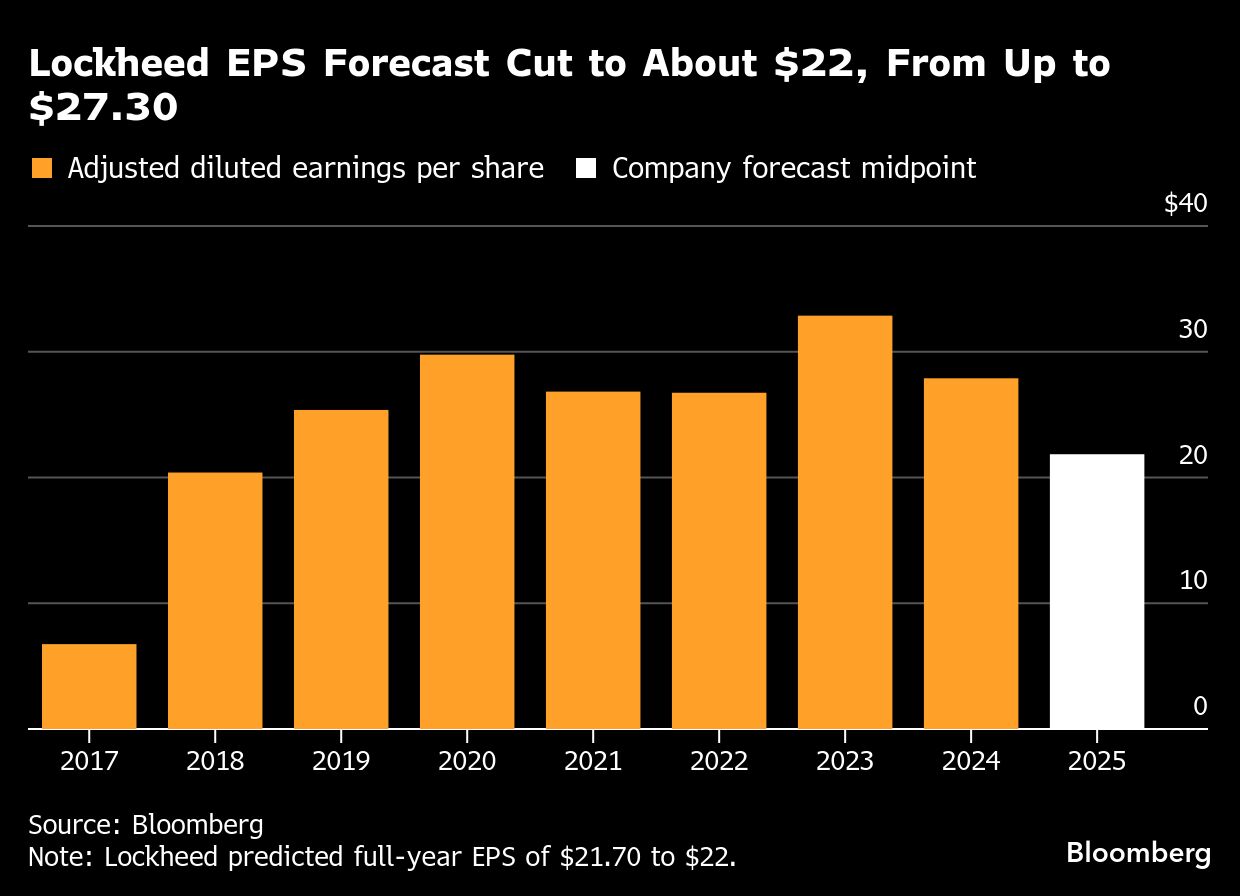
Lockheed Martin Faces Major Financial Setbacks
Lockheed Martin Corp. surprised investors with a staggering $1.6 billion in charges and potential tax liabilities, leading to a sharp decline in its stock price. This comes as the defense giant continues to face challenges with its popular F-35 jet, which has been criticized for cost overruns and delays.
The company’s shares dropped nearly 11% on Tuesday, marking the biggest single-day decline since October 2021. This follows a disappointing earnings report that fell short of analyst expectations, along with a revised outlook for the year. The primary issues cited by the company include program losses from its secretive Skunk Works division and helicopter development projects for Canada and Turkey. Additionally, Lockheed reported $169 million in charges related to losing out on the U.S. Air Force’s F-47 fighter jet contract, which was awarded to Boeing Co.
In addition to these financial setbacks, Lockheed also warned of a potential $4.6 billion in additional taxes due to an accounting change, although it is currently contesting this matter with the Internal Revenue Service. These challenges were uncovered following a comprehensive review initiated by the company's new chief financial officer, Evan Scott, aimed at identifying risks and preparing the company for future growth opportunities.
Challenges and Criticisms
Analysts have noted that these developments highlight Lockheed’s ongoing struggles with execution problems on the F-35 program and high-profile contract losses in areas where it once dominated. For example, the replacement for Lockheed’s now-out-of-production F-22 was recently won by Boeing in an unexpected victory.
Despite these challenges, the Pentagon has significantly reduced its proposed purchase of F-35s for fiscal 2026. However, it has allocated more funds to Northrop Grumman Corp.'s Sentinel intercontinental ballistic missile program and B-21 stealth bomber. Analyst Scott Mikus from Melius Research pointed out that what was once a strength for Lockheed is now becoming a weakness, as the growth rate of its aeronautics division slows down.
The classified Lockheed program stems from a fixed-price contract awarded in 2018. The company estimated that the program would drain nearly $900 million from its cash flow through the end of next year. However, the customer remains open to revising the contract terms, given the program's importance to national security.
F-35 Program and International Demand
The F-35 is the world's most widely flown fifth-generation fighter and a key component of U.S. airpower. In recent months, Lockheed cleared a backlog of aircraft held up by software upgrades and delivered 50 units of the aircraft in the quarter. Foreign customers continue to show interest in the fighter, including the UK, which announced plans to add at least a dozen F-35A jets to its existing fleet of over 100 F-35B vertical takeoff and landing models.
However, a government spending watchdog recently warned that the program's costs had risen to £71 billion ($95.7 billion). This has raised concerns about the long-term viability of the project.
Financial Performance and Outlook
Lockheed’s operating profit fell by 65% to $748 million, compared to the $2.15 billion expected by analysts. Net sales of $18.16 billion also missed estimates. The company lowered its full-year earnings per share forecast to $21.70 to $22, down from a previous prediction of up to $27.30.
Analyst Ken Herbert of RBC Capital Markets noted that Lockheed will need strong performance in the second half of the year to meet its revised forecast. He pointed out that the current guidance implies a 6.7% revenue growth over that period, which he believes is higher than that of its peers.
Leadership Changes and Industry Trends
Lockheed’s former chief financial officer, Jesus “Jay” Malave, has recently been appointed as Boeing’s new finance chief, taking over from Brian West, who will leave in mid-August. Meanwhile, Northrop Grumman Corp. has raised its earnings guidance for the year, driven largely by the Sentinel program, which is set to replace the aging Minuteman III missile and is expected to cost over $140 billion.
These developments underscore the complex and evolving landscape of the defense industry, where companies must navigate financial challenges, shifting priorities, and intense competition.

Post a Comment for "Lockheed Faces $1.6 Billion Charges as New CFO Unveils Financial Scrutiny"
Post a Comment